skip to main |
skip to sidebar
Hey guys! Since we're getting close to spring (well, hopefully), I thought it would be a good time to talk about composting. I started a compost in my backyard at the beginning of last summer when I moved back to Duluth and loved it! I made it out of wire mesh and just attached it to the fence in our backyard - nice and easy. Here's a picture of it (unfortunately it hasn't been getting much use these last couple of months):

What is composting?
Composting creates an environment for organic waste (food scraps, yard trimmings, etc.) to quickly decompose into a dark soil-like material. Organisms such as insects, worms, and bacteria all help to break down the matter. It is a natural form of recycling!
Why should I start a compost? - less trash sent to landfills - cut down your garbage by hundreds of pounds each year
- reduced odors in household garbage cans
- putting food through an in-sink garbage disposal means it will have to be removed from the water at a treatment plant
What can I put in my compost?
A basic principle of composting is to remember to combine both "greens" and "browns". This ensures proper amounts of nitrogen and carbon, and provides protein and energy for the organisms that live in and decompose the compost. Greens include matter such as green leaves, fresh grass and plant trimmings, coffee grounds, tea bags, and raw fruit and veggie scraps. Some browns are dried grasses and leaves, straw, woodchips, twigs and branches, shredded newspaper, and sawdust.
(As a side note, make sure air can circulate through the compost pile. This can be done by occasionally turning and mixing it up with a shovel. Also, see to it that the pile stays moist, but not too wet.)
What can't I put in my compost?
If you plan to use your compost as a soil amendment, keep it free of seeded weeds, diseased plants, and pet doo-doo. Also, excluding foods containing meat, dairy, and oils will help prevent unwanted visitors such as raccoons and neighborhood dogs.
What can I use my compost for? - add the nutrient-rich matter to a garden or flowerbed
- mix it with existing soil to improve erosion control, soil fertility, and proper pH balance
What if I can't start a compost in my yard or I live on-campus?
There are some residential food waste drop sites here in Duluth: - The Western Lake Superior Sanitary District's (WLSSD) Yard Waste Compost Site at 27th Ave West & Courtland St. (During winter months, it moves to the Household Hazardous Waste Facility located at 27th Ave West & Courtland St.)
- WLSSD's Materials Recovery Center at Rice Lake and Ridgeview Roads
- Marshall Hardware at 4415 E. Superior St.
- Willard Munger Inn at 7408 Grand Ave
- Chester Creek Cafe at 1902 E 8th St.
Click here to view the hours for these drop-off sites.
This post is meant to be just a quick overview of composting, but there is much more that can be said about it! If you're interested in starting your own compost, visit these sites for more information and in-depth tips on how to get started:
Week 9
On Tuesday, we talked about advocacy in class and how it relates to the job of a health educator. To be honest, I hadn't realized what a big deal advocacy is. Or, for that matter, what exactly advocacy is! I guess I always assumed advocacy was only for really outspoken, politically involved individuals (which I definitely am not), so I shied away from the issue. I never really stopped to think much about it and how it related to lobbying and grassroots efforts, especially in connection with the health education profession. Now I realize that anyone can advocate for something they have an opinion about and an interest in. Advocacy doesn't have to be risky or scary, but it will take thought, planning, knowledge of the subject, and a time commitment. I have now changed my opinion and believe that willingness to advocate for a cause is just another positive characteristic of an involved citizen.
advocacy: the act of pleading or arguing in favor of something, such as a cause, idea, or policy; active support.
Along with this discussion, we were assigned the first part of our Advocacy Project. For this, we were supposed to find out who our political representatives are. This was good for me, because I'll admit I didn't know who all of my representatives were before looking them up for this assignment!
In class on Thursday of week 9, we discussed photography ethics and how to take quality photography in relation to our upcoming Photo Essay. We also talked about how photo essays are an effective way to advocate for under-served populations. I thought this was very interesting, because I hadn't thought of it that way before, but once it was mentioned I began to think of all the times I have seen this sort of advocacy in action.
Week 10
We did not have class this week since Dr. V. was out of town. I definitely enjoyed the extra time this gave me! Also, we all eased up a little on the blogging posts so they were less overwhelming than normal.
Our photo essays were due this week, and I'm looking forward to seeing the topics everyone chose! Earlier this week, I got quite frustrated with my photo essay, but I think it turned out alright. I ended up switching my topic, and also my LCD screen on my camera is broken so I can't use the settings (such as the flash!) or see exactly what is in the frame of each photo! But, like I said, things turned out fine. Looking back, I'm not sure why I didn't just borrow a camera from some one else... oh well.
Since I've been trying to make my life more environmentally friendly these past few weeks, I was excited to learn that some of my friends were interested in celebrating Earth Hour this past weekend. We kept all our electricity off for a couple hours on Saturday night and had a great time helping out our earth!
Well, I think that's about it for these past two weeks. I can't believe we're at the end of week 10 already -- the semester is just flying by!
Hello everyone!
Alright, so I know that all too often people think, "Well, what can I do? I'm just a college student," when it comes to being more environmentally friendly. We tend to think that "going green" is out of our control because we can't afford it, or because we live in rental housing -- the list of excuses can be quite long. Other times I hear my peers (and I'm not picking on anyone in this class, I'm talking about all college students in general) say they'll become more conscious of the environment "once I have my own house" or "once I'm out of college." Admittedly, I'm definitely guilty of this myself sometimes.
The question we need to be asking is, WHY WAIT? There are numerous ways that we can lessen our impact on the environment right now! I know we all know this, and we have all learned about new creative ways to do so over the past couple of weeks through class discussions and everyone's Share and Voice posts.
The purpose of my photo essay is to reinforce the idea that college students can -- and are -- making a difference right now, despite our temporary housing situations, limited budgets, hectic schedules, etc. All of these photos were taken at residences of UMD students and show simple ways to make your home, and life, a little bit greener.

Take turns among housemates making family-style meals. You'll use less electricity when cooking, less water on the dishes, and even less packaging because food will be purchased in bulk. As a bonus, you'll gain extra time on the nights it's someone else's turn to cook. Even if it's impossible to gather everyone for a meal, it is always nice to have leftovers waiting after a long day at school and work.

Find creative ways to reuse items, such as turning an empty jar of pasta sauce into a cool-looking drinking glass!


For items that can't be reused, be sure to recycle them.

Start a compost in your yard for food scraps and yard waste. This one was made last summer and used diligently until winter.

Speaking of food, try to purchase organic and local foods whenever possible.

Keep reusable bags in your cupboard or by the door so it is easier to remember them when heading to the store.

Buy natural cleaning products, or better yet, make your own.

Forget about those old, uncool, energy-wasting light bulbs...
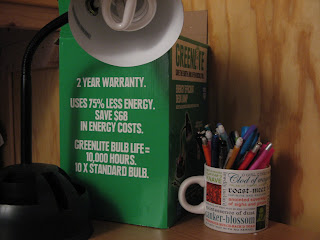
...and switch to more efficient bulbs instead.


Save energy by hanging clothes up to dry instead of using a dryer. This works especially well in summer when clothes can be hung up outside on a clothesline.

Keep the thermostat turned down, especially during times when no one is home or at night when everyone is asleep.
Make sure that precious heat is not escaping from your house - or that cold air is sneaking in. Plug up any holes...


...and put plastic over windows during the winter months.

Minimize vehicle use by biking and walking. It can be done, even during Duluth winters.
I hope this has inspired you to look for changes that could be made in your own homes!
Thanks for reading!
Hey guys!
As I'm sure you all know, this past Saturday, March 28th, was Earth Hour 2009. I had never heard about this event, but since it was brought to our attention weeks ago in this class, I was determined to participate!
On Saturday night, I ended up at my friends' house and a bunch of us were having a "Stone Soup" dinner. We managed to get our soup made by 8:30pm, and then we turned off all the lights, appliances, etc. in the house. Multiple candles were lit in the kitchen and dining room so that we could see and not spill food on each other (or ourselves). With no music, TV, or laptops, we all ended up having great conversation that otherwise may not have happened. Everyone loved the atmosphere so we ended up keeping everything off for the rest of the night instead of for just one hour!
Here are some pictures from the evening - they didn't turn out the greatest, but you get the idea. :)


I'm really glad I heard about this event so that I could take part in it! It was a great way to spend the evening, and as an added benefit, my friends and I got to spend some quality time together.

President
Barack Obama
Democrat
Contact Info
The White House
1600 Pennsylvania Avenue NW
Washington, DC 20500
Comments: 202-456-1111
Switchboard: 202-456-1414
FAX: 202-456-2461
Email: http://www.whitehouse.gov/CONTACT/
Website: http://www.whitehouse.gov/administration/president_obama/
Congresspersons
Senator Amy Klobuchar
Democrat
Contact Info
D.C. Office:
302 Hart Senate Office Building
Washington, DC 20510
Phone: 202-224-3244
Fax: 202-228-2186
Metro Office: 1200 Washington Avenue South, Suite 250
Minneapolis, MN 55415
Main Line: 612-727-5220
Main Fax: 612-727-5223
Toll Free: 1-888-224-9043
Email: http://klobuchar.senate.gov/emailamy.cfm
Website: http://klobuchar.senate.gov/index.cfm
Representative James Oberstar
Democrat
Contact Info
D.C. Office:
2365 Rayburn HOB
Washington, D.C. 20515
(202) 225-6211
Duluth Office:
231 Federal Building
Duluth, MN 55802
(218) 727-7474
Email: http://wwwc.house.gov/oberstar/zipauth.htm
Website: http://oberstar.house.gov/
Governor
Tim Pawlenty
Republican
Contact Info
Office of the Governor
130 State Capitol
75 Rev. Dr. Martin Luther King Jr. Blvd.
St. Paul, MN 55155
Telephone: (651) 296-3391
Toll Free: (800) 657-3717
Facsimile: (651) 296-2089
Email: tim.pawlenty@state.mn.us
Website: http://www.governor.state.mn.us/
State Legislators
Senator Yvonne Prettner Solon
Democrat
Contact Info
75 Rev. Dr. Martin Luther King Jr. Blvd.
Capitol Building, Room G-9
St. Paul, MN 55155-1606
Phone: 651-296-4188
Email: http://www.senate.leg.state.mn.us/members/member_emailform.php?mem_id=1061&ls=86
Website: http://www.senate.leg.state.mn.us/members/member_bio.php?district=07
Representative Thomas Huntley
Democrat
Contact Info
585 State Office Building
100 Rev. Dr. Martin Luther King Jr. Blvd.
St. Paul, MN 55155-1606
Phone: 651-296-2228
Email: rep.thomas.huntley@house.mn
Website: http://www.house.leg.state.mn.us/members/members.asp?district=07A
St. Louis County Board Chair
1st District Commissioner Dennis Fink
Democrat
Contact Info
Room 208
100 N. 5th Avenue West
Duluth, MN 55802
Phone: (218) 726-2458
Website: http://www.co.st-louis.mn.us/slcportal/SiteMap/HomePage/Departments/CountyBoard/tabid/554/Default.aspx
Mayor of Duluth
Don Ness
Democrat
Contact Info
Mayor's Office
Room 402, 411 West First Street
Duluth, MN 55802
Phone: (218) 730-5230
Fax: (218) 730-5904
Email: dness@duluthmn.gov
Website: http://www.duluthmn.gov/mayor/
In case anyone didn't see Erika's Share and Voice: Spring Break post, she asked us to post a picture from our spring break. Since I was fortunate enough to travel around Europe during my five-week break last year, I decided to lay low for this year's break and only made it as far as central Wisconsin. I didn't really think about taking any pictures that were related to the environment, but I just remembered this one and it made me laugh:
 The U.S. goes green!
How to go from this...

to this...

...in no time at all!
And the best part is, you can still be environmentally friendly because no toxic cleaner is involved!
So I'm sure you're wondering what this is all about, and why I have pictures of a microwave, right? Well, I returned to my house after going away for spring break, only to find that someone had definitely exploded some sort of tomato-y food in our microwave. Of course, no one wanted to clean it up.
Since we recently talked in class about our dependence on chemical products, I decided I wanted a "green"-er way to clean our microwave. Besides, it dawned on me that using chemical cleaners to clean a microwave is not a very healthy decision - I don't know about you, but the thought of chemical residue heating up and seeping into my lunch doesn't sound very appetizing.
Anyway, I found this great website about homemade cleaners and decided to give the microwave cleaner a try:
Microwave Cleaner
Mix 2T baking soda or lemon juice and 1 cup water in a microwave-safe bowl. Microwave for five minutes or until the liquid boils and condensation builds up inside the microwave. Wipe down.
This recipe worked like magic! I used to spend far too long scrubbing baked food off the microwave walls, but this made it possible to clean everything up in only a few minutes. And, best of all, it used baking soda and water - two INEXPENSIVE ingredients I always have on hand.
It was such a great feeling to know exactly what I was using to clean - no long lists of toxic chemicals. I think I'm going to try and make all my cleaners from now on!


 Posts
Posts

